


Who Is Mary Magdalene in France? The Return of the Divine Feminine
Updated: Sep 26
Hi, I’m Naïma, a professional oil painter originally from Normandy and now based in the South of France. My art is inspired by nature, the divine feminine spirit, and the deep journey of returning to who we truly are.
For many people today, Mary Magdalene has become a powerful symbol of the Divine Feminine — a modern spiritual and archetypal interpretation of a woman who occupies an important place in the Christian tradition.
In the Gospels, Mary Magdalene is presented as a devoted follower of Jesus and one of the witnesses to his resurrection. Yet over the centuries, her identity became intertwined with other women in the Gospels, and in Western Christianity she was increasingly associated with penitence and sexual sin. Although the Gospels never describe her as a prostitute, this image became deeply influential and overshadowed other aspects of her story.
And yet… she never truly disappeared. Today, many women and spiritual seekers feel drawn to Mary Magdalene not only as a biblical figure, but as a symbol of qualities they associate with the Divine Feminine: embodied wisdom, spiritual authority, devotion, sensuality, intuition, and the freedom to reclaim one's full self.

In France especially, Mary Magdalene has become deeply woven into the landscape through centuries of devotion, pilgrimage, legend, and sacred tradition. From ancient grottoes to hilltop sanctuaries, forests, springs, and medieval villages, these places carry layers of stories that continue to inspire people today. For me, there is something about the land itself that makes her presence feel almost tangible.
This is a story of Mary Magdalene, the traditions that grew around her, her enduring place in the spiritual imagination, and how southern France became one of the most important landscapes associated with her.
Who Was Mary Magdalene?
Mary Magdalene, or Mary of Magdala, was a devoted follower of Jesus and an important disciple in the Gospel accounts.
In the canonical Gospels, she appears as a witness to Jesus’s crucifixion, the empty tomb, and his resurrection. Her role as one of the first witnesses to the resurrection gives her a particularly important place in the Christian tradition.
The Catholic Church now explicitly calls her “Apostle to the Apostles” and celebrates her liturgical feast on July 22 as a Feast, rather than as a memorial.
In later non-canonical Christian writings, especially the Gospel of Mary, Mary Magdalene is given an even more prominent spiritual role. She is portrayed as receiving teachings from the risen Jesus and sharing her understanding with the other disciples. Her spiritual authority creates tension with some of the male disciples, particularly Peter.
Why Women Are Reconnecting With Mary Magdalene Today
Something about Mary Magdalene's story continues to resonate with women today.
We are living through a time when many women are exploring their relationship with intuition, embodiment, sensuality, creativity, spirituality, and personal power. We are questioning old ideas about what it means to be feminine, and remembering that softness and strength, devotion and independence, body and spirit do not have to be opposites.
For many women today, Mary Magdalene has become a powerful archetype through which to explore these qualities.
In her story, we can see:
A woman who followed Christ with courage and devotion
A woman whose testimony became central to the story of the resurrection
A woman whose spiritual authority has been interpreted and debated across centuries
A woman whose image has evolved from the biblical disciple into a powerful symbol of feminine spiritual wisdom
Many women feel her as a mirror. For me, she holds the archetype of the woman whose voice and authority were too often overshadowed by the interpretations placed upon her — and whose story is now being looked at again with fresh eyes.
Perhaps this is one reason she speaks so strongly to the modern imagination.
Connecting with Mary Magdalene today can take many forms. For some, she is a beloved saint; for others, a biblical figure, historical subject, spiritual archetype, or symbol of the Divine Feminine.
For me, her story invites a deeper remembering:
What happens when a woman's body, intuition, devotion, sensuality, and spiritual authority are no longer seen as separate things?
Perhaps what returns through Mary Magdalene is not a forgotten historical identity, but an invitation — to reclaim the parts of ourselves that were never meant to be divided.
What Is the Divine Feminine?
For me, the Divine Feminine is not about biological gender. It is a spiritual principle — an expression of the sacred that can be experienced within all beings.
It represents qualities such as:
Creation
Intuition
Receptivity
Cycles
Sensuality
Compassion
Inner knowing
Emotional intelligence
Connection to Earth
Flow rather than force
Across different cultures and religious traditions, the sacred has been expressed through feminine deities, feminine imagery, and qualities associated with the feminine. These traditions are very different from one another, but they offer many fascinating ways of imagining the relationship between the feminine, the natural world, and the divine.

Some examples include:
Isis in ancient Egypt
Inanna in ancient Sumer
Sophia, divine Wisdom, in Jewish and Christian traditions and later Christian mystical writings
Shekhinah, the divine presence that acquired distinctly feminine qualities in Jewish mysticism
Gaia, the personification of the Earth in ancient Greek tradition
These traditions should not be understood as one continuous or universal tradition of the “Divine Feminine.” They emerged in very different historical and religious contexts. Yet together, they show that feminine imagery and qualities have long played important roles in humanity's understanding of the sacred.
At the same time, many religious traditions have developed predominantly masculine language and imagery for the divine, while feminine forms of religious symbolism have sometimes been marginalized or reinterpreted.
The history is complex, however, and it is not simply a story of the feminine being erased.
For me, the Divine Feminine is not about replacing the masculine with the feminine. It is about remembering that the sacred can be experienced through many qualities — including those traditionally associated with the feminine — and that these qualities can belong to all of us.
Symbols of the Sacred and Divine Feminine
Symbols can carry many layers of meaning. Some have long been associated with Mary Magdalene in Christian art and tradition, while others have become part of the broader symbolic language of the Sacred and Divine Feminine.
For me, these symbols speak to themes of beauty, embodiment, intuition, transformation, devotion, nature, and spiritual awakening.
Their meanings are not fixed or universal; they have evolved across different cultures, religious traditions, and artistic interpretations.
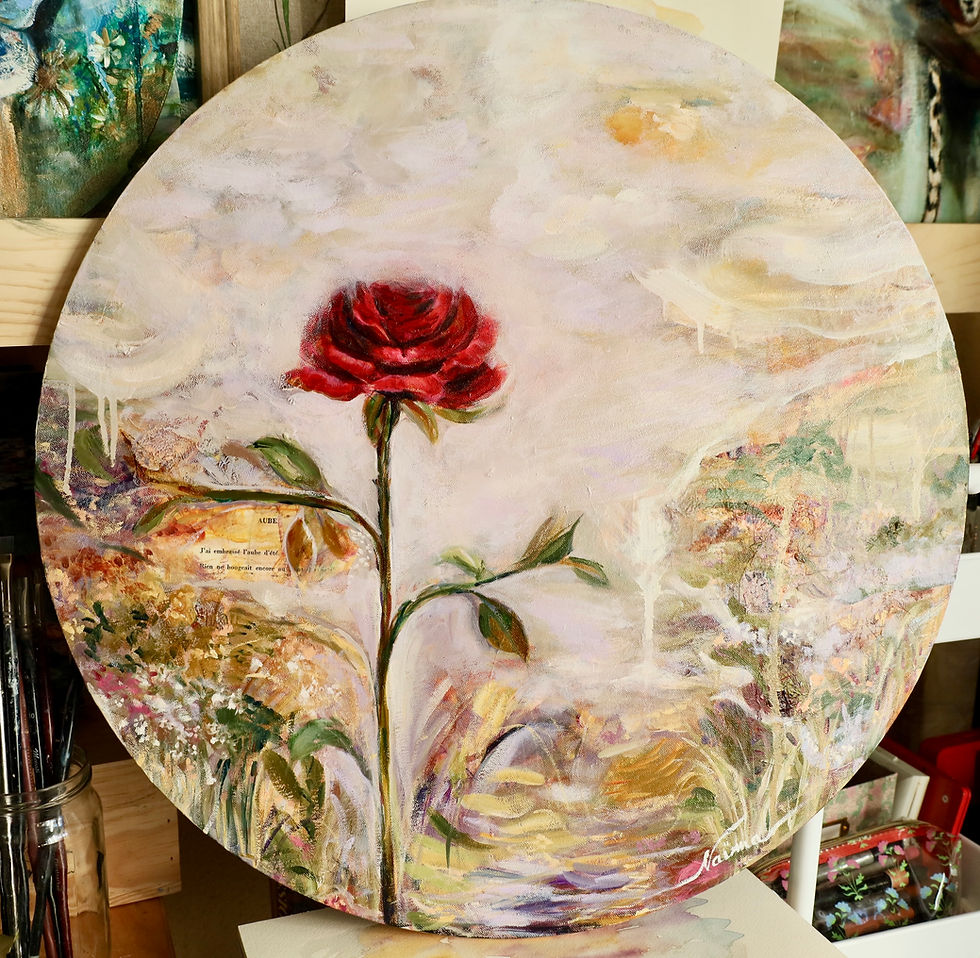
The Rose: Often associated with love and beauty, the rose also appears in Christian devotional art connected with Mary Magdalene. For me, it evokes sacred love, sensuality, beauty, and the unfolding of the soul.
The Chalice / Grail: A vessel can evoke receptivity, creation, nourishment, and the sacred feminine. The association with the womb and the Grail belongs primarily to later symbolic and spiritual interpretations rather than to the historical Mary Magdalene.
The Moon: In modern Sacred Feminine symbolism, the moon is often associated with cycles, intuition, mystery, and transformation. This is a broader feminine symbol rather than a specific historical symbol of Mary Magdalene.
Long Hair: Flowing hair became an important part of Mary Magdalene's artistic representation in Western Christianity. It has carried different meanings, including beauty, sensuality, penitence, and her transformation from sinner to saint.
Red and Gold: These colours can evoke passion, life, devotion, sacredness, and light in contemporary spiritual and artistic symbolism. Their meanings vary across cultures and periods.
Perfume / Anointing Oil: This is one of the strongest traditional connections to Mary Magdalene. The Gospel narratives describe women anointing Jesus, and medieval Western tradition increasingly associated these anointing stories with Mary Magdalene. The ointment jar became one of her most recognizable artistic attributes.
The Cave / Grotto: The cave is particularly meaningful in the French Magdalene tradition because Sainte-Baume is traditionally identified as the place where Mary Magdalene spent her final years. Beyond that tradition, I experience the cave as a powerful symbol of retreat, mystery, transformation, and return to the depths of the self.
Mary Magdalene and the Feminine Awakening
For many people today, the renewed interest in Mary Magdalene reflects a wider desire to reconnect with ourselves — with our bodies, intuition, creativity, spirituality, and inner authority.
In this contemporary spiritual understanding, Mary Magdalene can be experienced as an archetype of feminine awakening: a woman whose story invites us to look again at qualities that have sometimes been diminished, misunderstood, or separated from the spiritual life.
We are remembering:
Our bodies are sacred
Our intuition is worthy of listening to
Our creativity can be a spiritual expression
Our softness can coexist with strength
Our wildness can hold wisdom
Mary Magdalene stands not above us, but beside us.
She doesn't speak to us through a historical record of these words, but through the meaning we give to her story today. For me, her presence becomes an invitation:
You are not broken. You were never meant to be small. Your love is holy. Your body is worthy of reverence. Your voice matters.
To walk with Mary Magdalene, in this sense, is to explore a path of embodied spirituality — a place where the human and the sacred meet, and where heaven can be experienced not by leaving the body behind, but by inhabiting life more fully.
As an artist, I am deeply drawn to the Sacred Feminine ... to the relationship between feminine beauty, intuition, power, spirituality, and nature. I am always curious to learn, explore, and find new sources of inspiration, and Mary Magdalene is one of the figures who led me to explore these themes more deeply, particularly through the sacred landscapes and traditions of southern France because this is where I live.
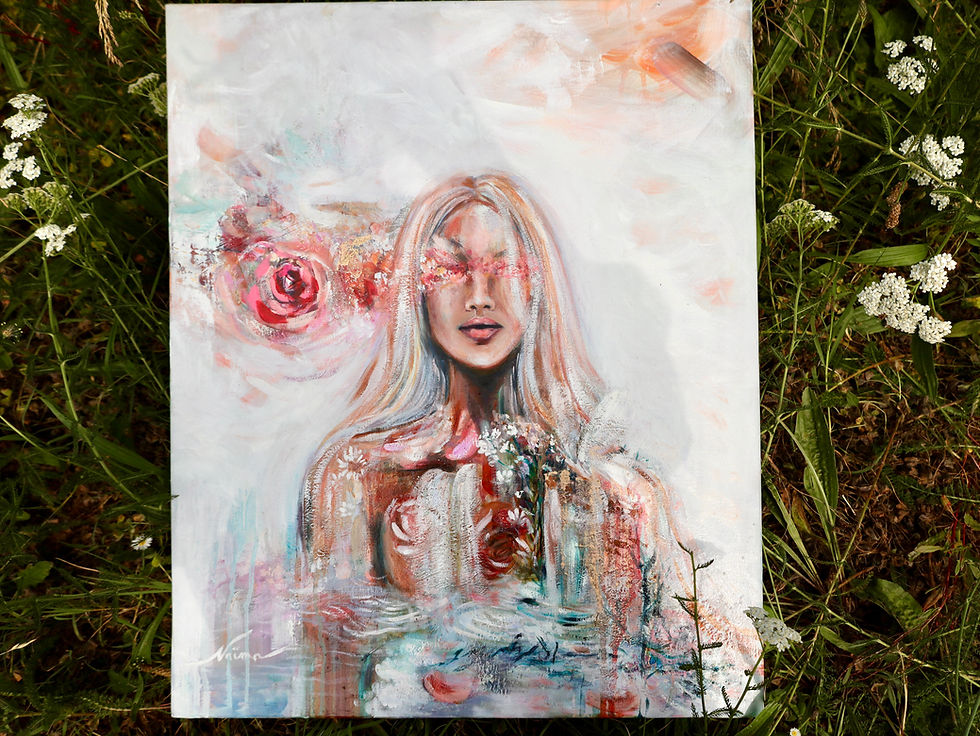
My art is not about depicting Mary Magdalene. Rather, it is inspired by the wider energy of the Divine Feminine — the mystery, beauty, strength, sensuality, intuition, and connection to nature that I feel drawn to express through my work.
It is important to clarify that Mary Magdalene is not the same woman as Mary, the mother of Jesus.
They are two distinct figures in the Christian tradition. For me, Mary represents the archetype of the Divine Mother — nurturing, protective, and compassionate — while Mary Magdalene represents the Priestess and Initiate: a woman of spiritual insight, devotion, courage, and embodied wisdom.
Over the centuries, Mary Magdalene was sometimes conflated with other women in the Gospels, particularly Mary of Bethany and the unnamed sinful woman. This contributed to the complex image of Mary Magdalene that developed in Western Christianity.
A note on history and tradition: Much of Mary Magdalene's connection to Provence comes from medieval Christian tradition, not contemporary historical sources. The Gospels do not record her travelling to France. Her arrival in Provence, life at Sainte-Baume, and the relics at Saint-Maximin belong to a long and influential tradition that became part of France's spiritual and cultural history.
For me, these traditions remain meaningful for what they have carried through generations: devotion, contemplation, feminine spiritual authority, and the memory of one of the first witnesses to the resurrection.
avec amour,
Naïma

About the Artist

Naima Namaste is a French contemporary artist whose original paintings explore the profound relationship between women, nature and the wild. Inspired by symbolism, intuition and the beauty of the natural world, she creates soulful, collectible artworks that invite moments of reflection, connection and wonder. Every painting is created by hand in her atelier in the south of France.