


The Alpha Wolf Myth: What Wolves Actually Teach Us About Family
Updated: Sep 26
There is something about wolves that has always touched something very deep inside me.
I have loved wolves since I was a child. They have always been my favorite animal, and throughout my life I have felt a connection with them that I have never really been able to explain.
Later, during my artistic journey, I discovered that I was born under the Wolf Moon in January. I don't know if there is a reason for this connection, but I like to think that perhaps there is something meaningful in the fact that the wolf has always been part of my life.

Since 2011, I have traveled to different parts of the United States, Canada, and Finland in search of wild wolves and wild places. I was fortunate enough to see wolves in Yellowstone and in Jasper and Banff National Parks in Canada. I also traveled to Vancouver Island hoping to see the wild sea wolves there. I didn't see them, but I found their tracks.

And sometimes, even when you don't see the animal itself, you can feel its presence.
Those journeys gave me so much more than encounters with wolves. I experienced ancient forests, incredible landscapes, bears and grizzly bears, and places where I felt deeply connected to the natural world.
All of these experiences have shaped the person I am today, and they continue to inspire my art.
And the more I learned about wolves, the more I realized that one of the things we have been taught about them for decades is not quite the way we thought.

The myth of the alpha wolf
For a long time, we were taught that a wolf pack was ruled by an alpha male and alpha female.
We imagined a group of wolves constantly competing for dominance, with the strongest wolf fighting its way to the top and becoming the leader of the pack.
It is an image that became deeply embedded in our culture. We use “alpha” to describe dominant people, relationships, workplaces, and even human families.
But when we look at naturally formed wild wolf packs, the story is much more interesting.
The modern understanding of wolf social behavior comes in large part from observations of wolves living in the wild. Wolf researcher L. David Mech, who himself helped popularize the study of wolf social behavior, explained that much of the early research behind the alpha concept came from captive wolves that had been artificially grouped together rather than from naturally formed family packs. (US Geological Survey)
L. David Mech (born in 1937) is an American zoologist and biologist, internationally recognized as one of the foremost experts on the gray wolf (Canis lupus). A leading research scientist and professor, he has been studying wolf behavior and ecology in the field since 1958.

In the wild, the typical wolf pack is primarily a family.
The breeding male and female are not simply two wolves who fought their way to the top and now rule over everyone else. They are the parents.
Their offspring make up much of the pack, sometimes including young wolves from several different years, and pack composition can vary. (Parcs nationaux des États-Unis)
This doesn't mean that wolves have no hierarchy or dominance relationships. They do. Parents are generally dominant over their offspring, and wolves communicate status and social relationships in many ways.
But calling the parents “alpha wolves” can give us the wrong impression.
The more meaningful word is family.

A wolf pack is a family-based social unit
A wolf pack is a family-based social unit built around relationships.
The parents have important responsibilities, but the survival of the family is not based on one wolf controlling everyone else.
Wolves cooperate.
They hunt together. They defend their territory. They communicate. They share food. They care for their young.
Wolf pups are cared for not only by their mother and father but also by other members of the pack. Wolves are considered cooperative breeders, meaning that several members of the social group can contribute to raising the young. (Parcs nationaux des États-Unis)
Older offspring can remain with the family and help with younger pups before eventually leaving to establish lives of their own. (Parcs nationaux des États-Unis)
There is a division of roles within the family. Research by Mech found that the breeding male and female can take different but overlapping leadership roles, with males tending to initiate more activities associated with travel and foraging, and females playing a particularly important role in pup care and protection. Their leadership can therefore be understood as complementary rather than as one individual simply ruling the group. (US Geological Survey)
This is what I find so beautiful about the wolf family.
Their strength comes from the group.
Each wolf is an individual, but each is also part of something larger.
The family matters.
The relationships matter.
The contribution of each member matters.

Strength without domination
I think this is where wolves can make us reflect on ourselves.
We often associate strength with dominance.
We imagine that being strong means being the one who controls, the one who decides, the one who is above everyone else.
But wolves offer us another image of strength.
A family can have leadership without domination.
Parents can guide their children without needing to silence them.
Different individuals can have different roles without one person needing to be more important than everyone else.
There is responsibility. There is structure. There are social relationships and dominance.
But there is also cooperation.
And cooperation is essential to wolf family life. Wolves live in territorial family groups and work together to capture prey, raise young, and defend resources. (Parcs nationaux des États-Unis)
Of course, wolves are wild animals, and I don't want to romanticize them or pretend that their lives are perfectly peaceful. Wolves compete with other packs, defend their territories, and can be extremely aggressive toward neighboring wolves. (Parcs nationaux des États-Unis)
But within the family, there is something remarkably cooperative.
And this is the part of their world that speaks to me.

What wolves can teach us about human families
When I look at wolves, I naturally think about human families.
To me, a healthy family is not one where one person rules over everyone else.
Parents have an important role. They protect their children. They guide them. They provide safety, boundaries, love, and support.
But I also believe that children should be listened to.
Their voice matters.
Their feelings matter.
Their ideas matter.
And as they grow older, they become individuals with their own experiences and their own understanding of the world.
Listening to a child does not mean giving up your responsibility as a parent.
It means recognizing that every person in the family has value.
Perhaps this is one of the things that wolves can remind us of: a family can be strong without being ruled by one individual.
Women and wolves
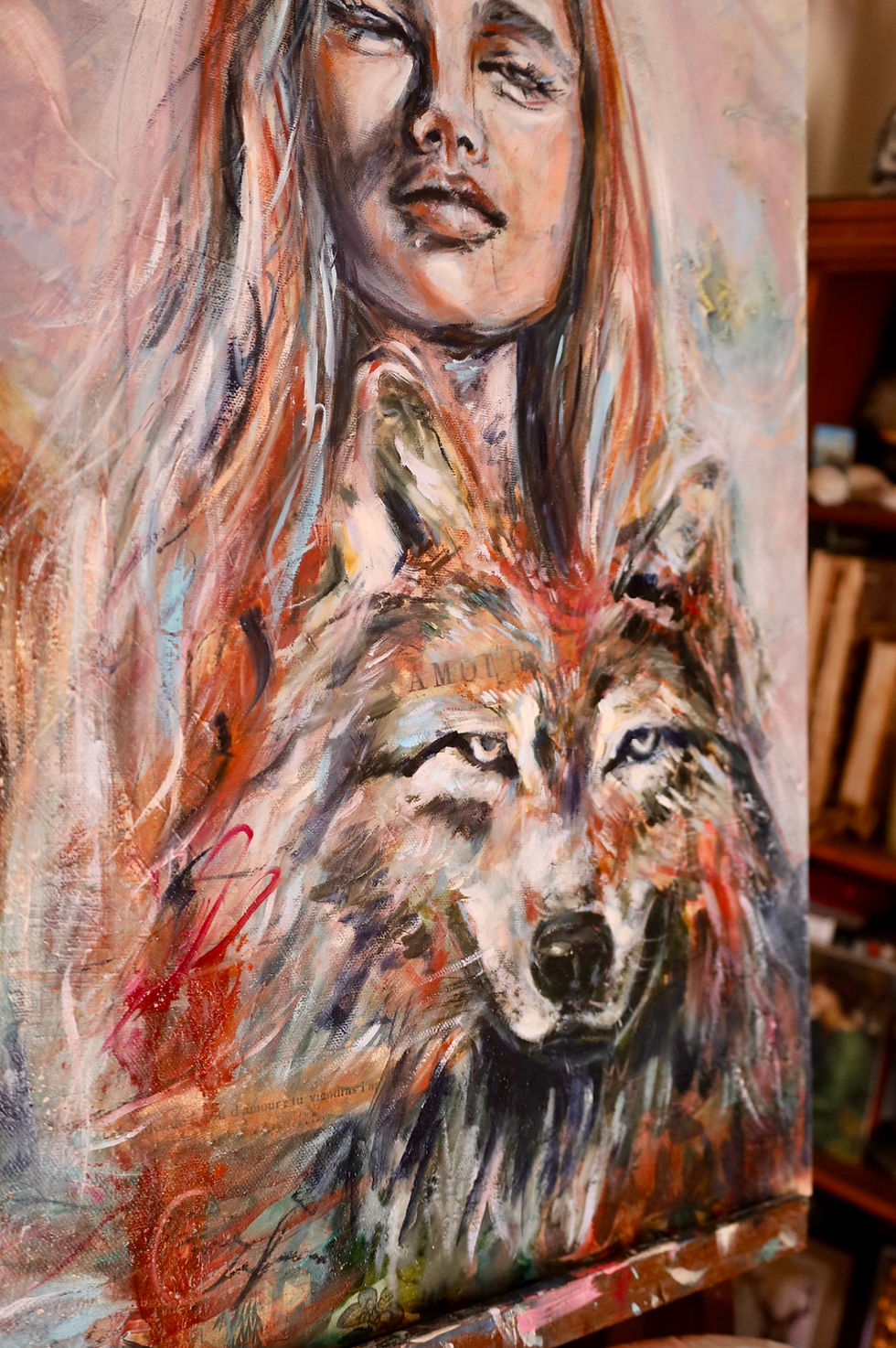
This is also why I feel such a strong connection between women and wolves.
As an artist, I love painting women alongside wolves.
There is something about the two together that feels deeply natural to me.
I see strength.
Grace.
Power.
Intuition.
Protection.
Tenderness.
Freedom.
I see qualities that I associate with the feminine ...not because all women are the same, or because women are somehow inherently more nurturing than men, but because the feminine, for me, represents a way of being connected to life.
There is a strength that doesn't need to dominate.
There is power in protection.
There is power in nurturing.
There is power in intuition.
There is power in tenderness.
And I see all of these qualities in the wolf.
The mother wolf is especially meaningful to me.
She protects her offspring. She cares for them. She is part of a family where the survival of the young depends on cooperation between several members of the group.
She doesn't need to dominate the family to be powerful.
Her strength is in what she gives, what she protects, and the relationships she helps sustain.
This is something I often feel when I paint women.
The wild woman within
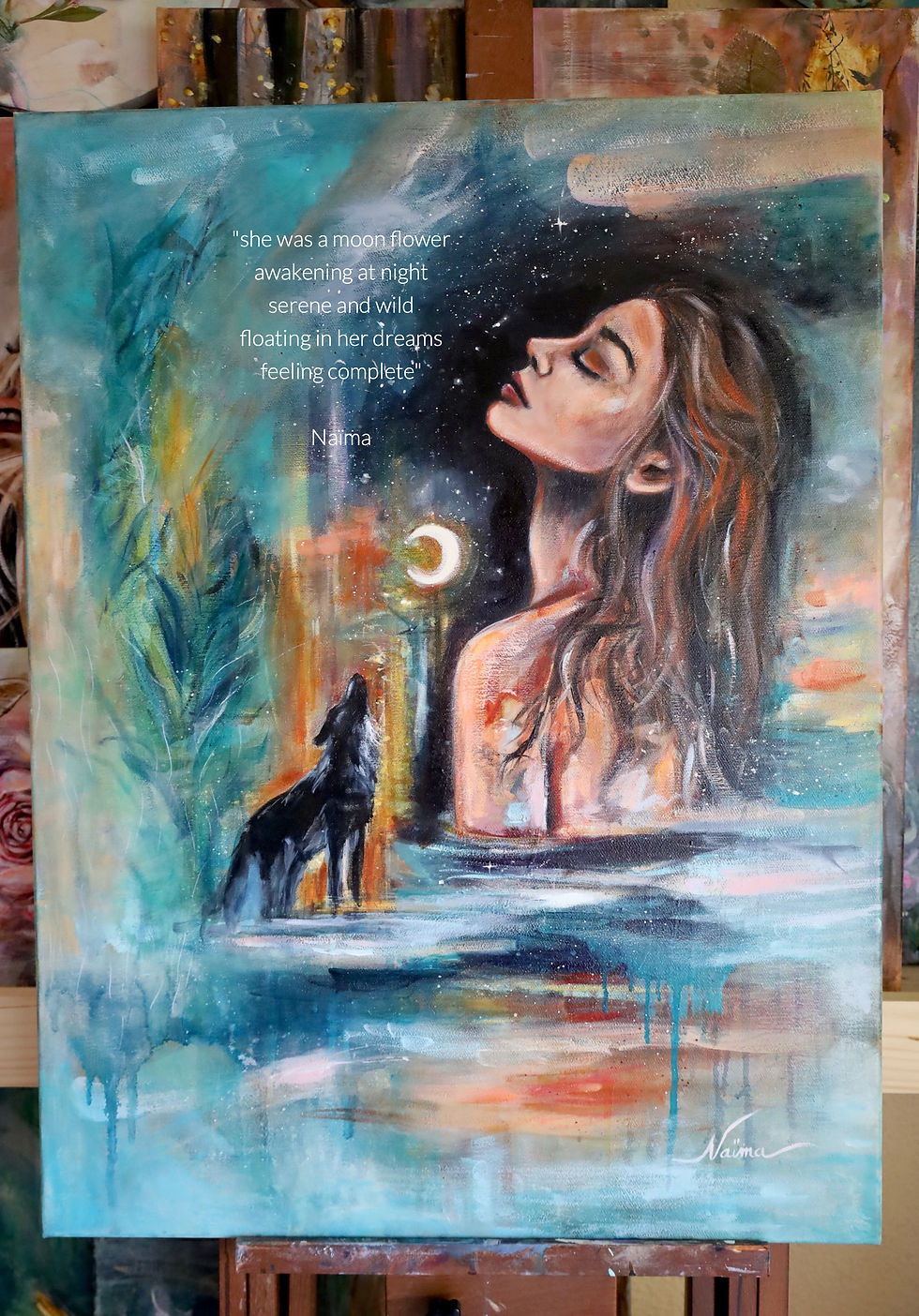
Perhaps this is why the image of a woman and a wolf together feels so powerful to me.
The wolf becomes a mirror.
A reflection of something that still lives inside us.
Something instinctive.
Something intuitive.
Something that has not been completely domesticated by society.
There is a part of us that knows.
A part of us that can feel something before we can explain it.
A part that knows when to protect.
When to stand our ground.
When to be gentle.
When to leave.
When to run free.
I call this part of ourselves the wild.
But I don't mean wild as aggressive or violent.
I mean wild as alive.
Connected.
Instinctive.
Free.

The tenderness of the wild
This is also what I want to show through my art.
When we talk about wild animals, we often focus on their strength, their aggressivity (especially wolves), their ability to hunt and survive.
But I have always been drawn to another side of the wild.
The tenderness.
The quiet moments.
A lone wolf resting.
The softness in an animal's eyes.
I want to show that the wild is not only harsh.
The wild can be tender.
And perhaps this tenderness is something we have forgotten to recognize in ourselves.

Remembering our wild
This is at the heart of my art.
My paintings are about reconnecting with something that I believe is still inside us. Our instinct. Our intuition. Our connection to nature. Our capacity to love, protect, feel, and connect.
The part of us that remembers that we are not separate from nature.
We are nature.
The wolf reminds me of this.

Not because wolf society is exactly like human society.
But because there are things in their lives that we can recognize: family, connection, cooperation, protection, belonging, and the importance of the group.
The wolf is not the “alpha” ruling over everyone else.
The wolf is part of a family.
And the family survives together.
That, to me, is one of the most beautiful things about the wolf.
And perhaps it is something worth remembering about ourselves.
The wild is not lost.
It is still within us.
Sometimes, we simply need to remember.
Women and Wolves: A Connection to the Feminine
For me, painting women and wolves together is a way of exploring this connection between the human and the wild.
I see the wolf as a symbol of the feminine qualities I want to honor: strength without domination, protection without control, tenderness without weakness, and intuition without the need to explain everything.
The woman and the wolf together remind me that we don't have to choose between being strong and being soft.
We can be both.
We can be fierce and gentle.
Independent and connected.
Protective and compassionate.
And perhaps this is what I love most about the wolf: she reminds us that there is a wild part of us that has never truly disappeared.
It is simply waiting to be remembered.
This is the wild I paint.
The wild I feel.
The wild I remember.
Naïma
DISCOVER MORE OF MY ART INSPIRED BY WOLVES AND THE WILD WITHIN
stay wild!
Naïma
About the Artist

Naima Namaste is a French contemporary artist whose original paintings explore the profound relationship between women, nature and the wild. Inspired by symbolism, intuition and the beauty of the natural world, she creates soulful, collectible artworks that invite moments of reflection, connection and wonder. Every painting is created by hand in her atelier in the south of France.
